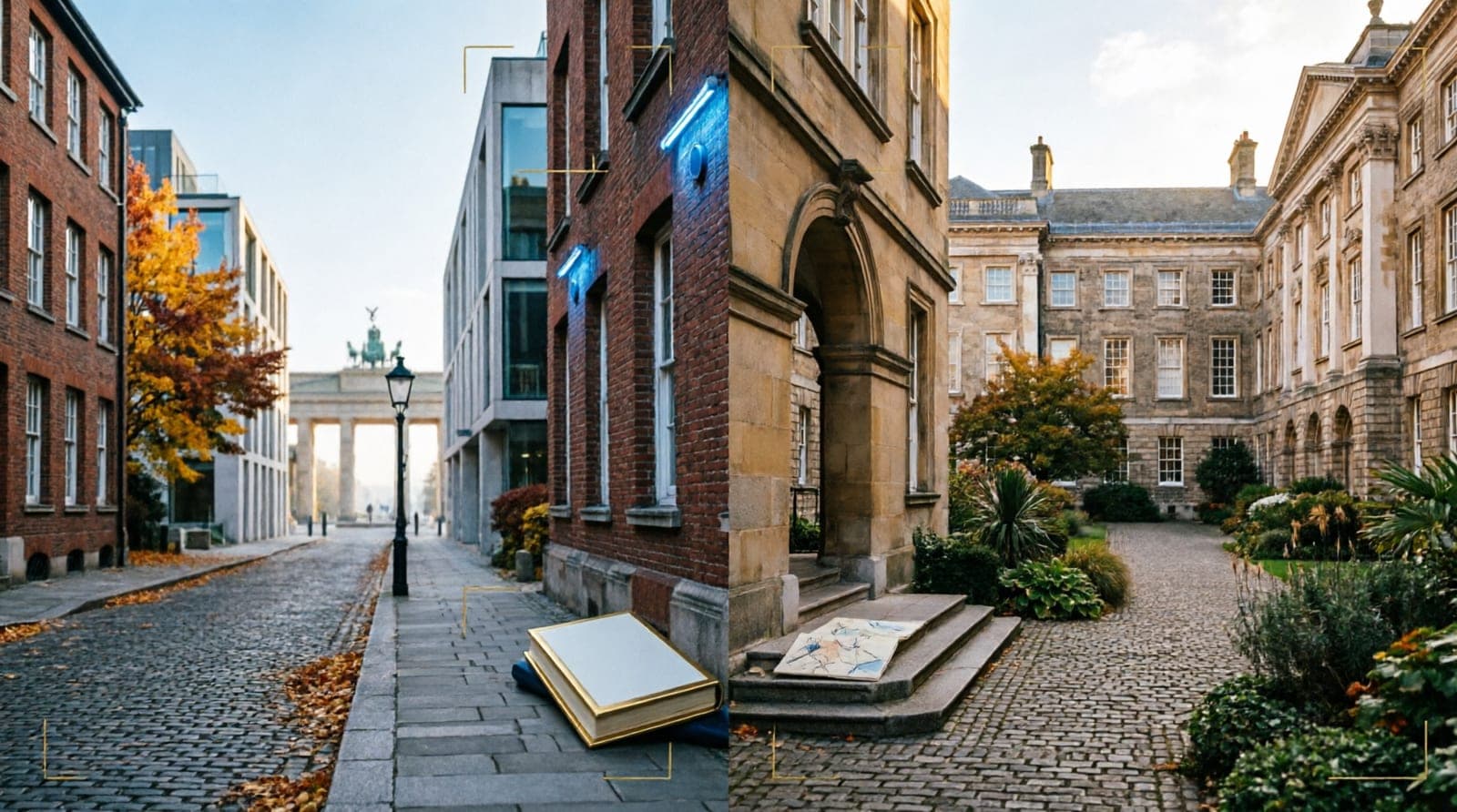
Choosing between Germany and Ireland for a Master’s degree is not as simple as comparing university rankings or tuition fees.
Both countries offer internationally recognised universities, access to the European job market and opportunities to remain after graduation. But the experience can be very different.
Germany is often the first choice for students looking for lower tuition costs, a strong engineering and industrial economy and a longer post study job search period.
Ireland attracts students who want an English speaking environment, a large concentration of international companies and the possibility of completing a Master’s in one year.
The right choice depends on your course, budget, career plans and how comfortable you are with the local language and job market.
Here is how Germany and Ireland compare in 2026.
Germany vs Ireland for Masters at a glance
| Factor | Germany | Ireland |
|---|---|---|
| Typical Master’s duration | Often 1.5 to 2 years | Many taught Master’s are 1 year |
| Tuition at public universities | Most Master’s programmes have no tuition, but exceptions exist | Generally €12,000 to €40,000 for non EU postgraduate study based on the latest national fee table |
| Living costs | Around €900 to €1,200 per month depending on city | Often higher in major cities, especially Dublin |
| Proof of funds | €11,904 for 2026, equivalent to €992 per month | €10,000 for an academic year |
| Part time work while studying | Up to 140 full days or 280 half days a year | Up to 20 hours per week during term and 40 hours during permitted holidays |
| Post study period | Up to 18 months to find qualified employment | 12 months for Level 8 and up to 24 months for Level 9 or above |
| Main language advantage | Many English taught courses, but German is important for many jobs | English is the main language of higher education and everyday professional life |
| Strong areas | Engineering, manufacturing, automotive, IT, automation, energy, research | Technology, pharmaceuticals, life sciences, finance, business, data and ICT |
| Extra consideration for Indian students | APS verification is generally required for Indian academic qualifications | Standard Irish admission and immigration requirements apply |
Germany does not mean completely free education for every international student. Most public universities do not charge tuition for many Master’s programmes, but Baden Württemberg charges non EU students €1,500 per semester and some universities in Bavaria also charge tuition. For example, Technical University of Munich currently charges non EU students €4,000 or €6,000 per semester for many Master’s programmes, depending on the course. Students also pay a semester contribution.
Ireland is a very different financial proposition. The latest general postgraduate fee table published by Education in Ireland lists non EU tuition at €14,000 to €40,000 for Business, €15,000 to €30,000 for Engineering, €15,000 to €31,000 for Science and Technology, €12,000 to €23,000 for Arts and Humanities, and €11,000 to €30,000 for Medicine and Health Sciences. These figures are for 2025/26, so students applying for later intakes should confirm the exact fee with the university.
Tuition fees: Germany has a clear cost advantage, but read the fine print
This is probably the biggest reason Germany appears attractive to international students.
At many German public universities, students can complete a Master’s without paying traditional tuition fees. Instead, they pay a semester contribution, which covers student services and, depending on the university, may include transport or other services. DAAD currently puts the typical semester contribution at roughly €70 to €430.
That does not mean every German university is tuition free.
Baden Württemberg charges non EU students €1,500 per semester for eligible degree programmes. Bavaria has also introduced tuition at some institutions, with each university deciding its own fees. TUM is one of the most visible examples.
This is important because many students still search for “free universities in Germany” and assume every public university follows the same fee structure.
Ireland is much more straightforward in this regard. International students normally pay tuition, and the amount depends heavily on the university and course.
So, purely from a tuition perspective, Germany usually requires a much smaller education budget.
But tuition is only half of the calculation.
Cost of living: Germany is cheaper, but city selection matters
Germany is not a low cost country in every city, but student expenses are relatively manageable compared with several other Western European destinations.
DAAD estimates that students generally need around €900 to €1,200 per month depending on where they live. Rent is normally the biggest expense. The amount also covers food, transport, health insurance and everyday spending.
For the 2026 academic year, Germany requires international students applying for a study residence permit to demonstrate access to at least €992 per month, or €11,904 for a full year. This can be demonstrated through a blocked account, scholarship or other accepted forms of financial support.
Ireland also requires students to demonstrate access to funds. The current immigration requirement is €10,000 for a course leading to residence of more than eight months, with separate calculations for shorter stays. The Irish authorities explicitly state that students should not depend on casual employment to prove that they can support themselves.
The interesting part is what happens after you arrive.
Housing can be difficult in Ireland, particularly in Dublin. Education in Ireland's current accommodation guidance describes the Dublin market as highly competitive and difficult for students arriving from abroad.
Outside Dublin, costs can be more manageable. A January 2026 Education in Ireland guide for Limerick puts typical accommodation around €650 to €900 per month off campus and €690 to €810 for certain University of Limerick accommodation, with a practical overall student budget of around €1,000 to €1,200 per month including rent, food and transport.
So when building your budget, don't simply use the official €10,000 proof of funds figure as your expected real life annual spending.
It is an immigration requirement, not a guarantee that €10,000 will comfortably cover your entire year.
Course duration: Ireland can save you a year
This is one of the most important differences between the two destinations.
Ireland has a large selection of one year taught Master’s programmes. This can be particularly attractive to students who already have a clear career direction and want to return to the job market quickly.
Germany has many Master’s programmes that run for three or four semesters, with two years being common for 120 ECTS programmes. Individual courses can be shorter or longer, so the course structure needs to be checked before applying.
At first glance, a one year Master’s in Ireland looks more expensive because the tuition is higher.
But there is another way to look at it.
A two year programme means another year of rent, food, insurance, transport and other living expenses. It also means one additional year before entering full time employment.
That is why students should compare total cost to graduation, rather than only tuition.
A €20,000 Master’s in Ireland is not automatically more expensive in practical terms than a €0 tuition Master’s in Germany if the German programme takes an additional year and the student is living abroad throughout that period.
English language: Ireland is simpler
For an Indian student who wants to study entirely in English and work in an English speaking environment, Ireland offers an obvious advantage.
English is the language used across mainstream higher education and professional workplaces in Ireland. Education providers still set their own English requirements, and international students need to meet the relevant immigration requirements as well.
Germany has a large number of English taught Master’s programmes as well, particularly in technology, engineering, business and related fields.
The bigger issue in Germany is not necessarily the classroom.
It is the workplace.
Germany's Federal Employment Agency currently advises international professionals that good German language skills improve their chances of finding a job, and notes that many companies expect at least basic German. It also states plainly that English alone is often not enough.
That does not mean you cannot build a career in Germany with English.
It means the size of your job market can become much larger when you can work in German as well.
For an international student planning to spend two years in Germany, learning German alongside the degree can make a meaningful difference.
Part time work while studying
Both countries allow international students to work while studying, but the rules are different.
In Germany, students from outside the EU can generally work up to 140 full days or 280 half days per year. Student assistant roles have separate treatment under the regulations.
Germany's statutory minimum wage is €13.90 per hour from January 2026.
In Ireland, students on Stamp 2 can work up to 20 hours per week during term time and up to 40 hours during the permitted holiday periods.
Ireland's national minimum wage for workers aged 20 and above is €14.15 per hour from January 2026.
That sounds attractive on paper, but there is an important point students sometimes miss.
A part time job should be treated as additional income, not as the financial foundation of your education.
Your tuition, visa finances and accommodation should already be financially planned before you arrive.
Jobs after graduation: this is where the comparison gets interesting
The job market is not static in either country.
Germany continues to have significant demand for qualified professionals. The Federal Employment Agency's 2026 analysis found 157 occupational categories facing skills shortages in the 2025 labour market, with about half of advertised vacancies falling into shortage occupations.
Germany remains particularly relevant for engineering and industrial careers. Government sources highlight demand across automation, automotive, electric mobility, renewable energy, environmental technology and AI. In 2025, more than 120,000 engineers of foreign nationality were working in Germany, while around 76,000 engineering vacancies remained unfilled.
Technology is also significant. Germany had around 1.15 million ICT professionals in employment subject to social insurance contributions in 2025. At the same time, the labour market has become more selective. ICT vacancies recorded by the Federal Employment Agency fell in 2025, while demand increasingly shifted towards more specialised skills.
Ireland has a very different economic structure.
The country has a strong concentration of global technology, life sciences, engineering and financial services companies. In the first half of 2026, IDA Ireland reported 190 investments with commitments for more than 10,400 jobs, including significant activity in technology, life sciences, engineering and financial services.
Ireland's current Critical Skills Occupations List includes a broad range of ICT roles, software development, IT business analysis, engineering, science and healthcare professions. The current list took effect on 13 May 2026.
That makes Ireland particularly relevant for graduates targeting sectors such as technology, software, data, pharmaceuticals, biotechnology, medical devices, engineering and financial services.
The important word here is targeting.
A degree from either country does not automatically create a job.
Your specialisation, previous experience, internship exposure, technical skills, portfolio, communication skills and ability to match the local market all matter.
Post study work rights
This is one of the strongest reasons international students consider both countries.
Germany
After graduating from a German university, a non EU student can apply for a residence permit for up to 18 months to look for qualified employment.
During this period, graduates can work in any type of occupation while looking for qualified employment.
Once they receive a suitable skilled job, they can move to the appropriate work residence permit or EU Blue Card route. Graduates of German universities can also qualify for a settlement permit after more than two years of employment in Germany, subject to the applicable requirements.
The 18 month job search period is significant because it gives graduates more time to make the transition from university to professional employment.
Ireland
Ireland operates the Third Level Graduate Programme.
Graduates with a Level 8 qualification can receive up to 12 months under Stamp 1G.
Graduates with a Level 9 or higher qualification, which includes a typical taught Master’s, can receive up to 24 months, provided the relevant conditions are met. The permission is structured in two 12 month periods.
During Stamp 1G, graduates can work full time, but they cannot run a business or be self employed. To stay beyond the graduate permission, they need to move into an employment route that qualifies for an employment permit.
Ireland has also increased its employment permit salary thresholds.
For 2026, the official minimum annual remuneration table lists €40,909 for a Critical Skills Employment Permit where a relevant degree applies. A separate lower threshold exists for eligible recent graduates under the Critical Skills graduate category, subject to the relevant rules.
For students thinking beyond graduation, this matters. Getting the first job is one step. Finding a role that fits the country's employment permit rules is another.
What about long term settlement?
Germany and Ireland both have routes that can lead towards longer term residence, but neither should be treated as an automatic outcome of completing a Master’s.
Germany allows graduates of German universities to apply for settlement after more than two years of employment, provided the relevant legal requirements are met.
In Ireland, a person working under a Critical Skills Employment Permit can become eligible for a Stamp 4 upgrade after 21 months of employment under that permit, subject to the applicable requirements. Stamp 4 allows employment without an employment permit.
The important point is that graduation alone does not create permanent residence.
Your immigration status after graduation depends on what you do next.
Admission and visa process for Indian students
Germany has one additional process that Indian students need to understand early.
For students with Indian academic qualifications, APS verification is generally required as part of the German student visa process. APS India verifies academic documents and educational qualifications and operates under the Science Section of the German Embassy in New Delhi.
The German missions in India also state that students who have obtained school or university qualifications in India will almost always require an APS certificate, subject to specific exemptions.
This makes timing important.
Students should not wait until they receive a university offer to start understanding the APS process.
Germany can also have more variation in application deadlines because universities set their own programme requirements and deadlines. DAAD listings show that some programmes accept applications for both winter and summer semesters, while others have only one intake or much earlier deadlines for non EU applicants.
Ireland's application process is usually easier to understand from an English speaking student's perspective, but admission requirements remain university and course specific.
The financial documentation still needs serious preparation. For Irish study visas, students must demonstrate access to at least €10,000 for an academic year in addition to tuition requirements, and the immigration service expects documentary evidence of the funds.
Scholarships
Germany has a broad scholarship ecosystem, with the DAAD scholarship database listing programmes for international students and graduates across a wide range of subjects.
The availability of funding depends on nationality, course, academic profile and scholarship programme, so there is no single “Germany scholarship” that every international Master’s student can apply for.
Ireland also has a government backed scholarship programme.
For 2026, the Government of Ireland International Education Scholarship offered 60 scholarships for one year of study at NFQ Level 9 or 10. Each award includes a €10,000 stipend and a full fee waiver from the host institution for the scholarship year. It is highly competitive and requires an offer from an eligible Irish institution.
For most students, scholarships should be treated as an opportunity rather than something to build the entire financial plan around.
Which country makes more sense for different students?
A student with a strong engineering background who wants to work in automotive, mechanical engineering, electrical engineering, industrial automation, manufacturing, energy or advanced engineering may find Germany particularly relevant. Germany's industrial base is huge, and its current labour market continues to show significant demand for engineers and other specialised professionals.
A student targeting software, data, artificial intelligence, technology consulting, pharmaceuticals, biotechnology, medical devices, financial services or business analytics may find Ireland particularly attractive because of the country's concentration of international companies and its current Critical Skills framework.
A student whose biggest priority is keeping tuition costs low will naturally look closely at Germany.
A student who values an English speaking environment and wants a one year Master’s may lean towards Ireland.
And a student who wants to build a long term career in Germany should seriously consider learning German alongside the degree.
Germany vs Ireland: the decision should be about your career, not just your university
There is a temptation to ask one simple question:
“Which country is better for a Master’s?”
That is probably the wrong question.
A better question is:
“Which country gives me the strongest combination of course, cost, employment opportunity and immigration options for the career I actually want?”
Consider a student with an engineering background.
Germany could offer a lower tuition burden, a two year degree, access to a large industrial economy and 18 months to search for work after graduation. The trade off is that German can become increasingly important when applying for jobs.
Now consider a computer science graduate who wants to move into technology, data or AI and prefers an English speaking environment.
Ireland may offer a shorter Master’s, an English speaking workplace, strong multinational presence and up to two years under the graduate programme after a qualifying Level 9 degree. The trade off is substantially higher tuition and a difficult housing market in places such as Dublin.
Neither route should be chosen simply because someone on social media says it has the “best PR”.
The course and the job market come first.
Final comparison
Germany
Germany is particularly interesting for students who care about tuition costs, engineering, industrial careers, research, technology and a longer period to find qualified work after graduation.
The biggest advantages are the large number of public universities with low or no tuition for many Master’s programmes, the strength of the engineering and industrial economy and the 18 month graduate job search route.
The biggest challenges are bureaucracy, housing in popular student cities and the importance of German for a large part of the labour market.
Ireland
Ireland is particularly interesting for students who want to study in English, finish a Master’s quickly and target technology, pharmaceuticals, life sciences, finance, business or other internationally oriented sectors.
The biggest advantages are the English speaking environment, the large number of international companies, many one year Master’s programmes and the 24 month graduate route for qualifying Level 9 graduates.
The biggest challenges are tuition fees and accommodation costs, especially in Dublin.
So, Germany or Ireland?
The answer depends on the student.
Choose Germany when lower tuition, engineering or industrial careers, research and a longer job search period are major priorities.
Choose Ireland when an English speaking environment, a one year Master’s, multinational employers and a technology, pharmaceutical, finance or business career are major priorities.
Before making the final choice, compare the actual universities and courses you are considering. Look at tuition, duration, modules, internship options, location, accommodation, graduate outcomes and the kinds of jobs available in your field.
That is far more useful than choosing an entire country first and trying to make a course fit afterwards.
A final note for Indian students
The biggest mistake is to compare only tuition fees.
A realistic study abroad calculation should include:
Tuition + living costs + visa and financial requirements + course duration + part time work rules + post study work period + employability in your field.
Once those numbers are placed side by side, the decision often becomes much clearer.
Information in this article has been checked against official German and Irish government, immigration, education and labour market sources available in October 2026. Immigration rules, university fees and employment regulations can change, so students should verify the final requirements with the relevant university and government authority before submitting an application.