
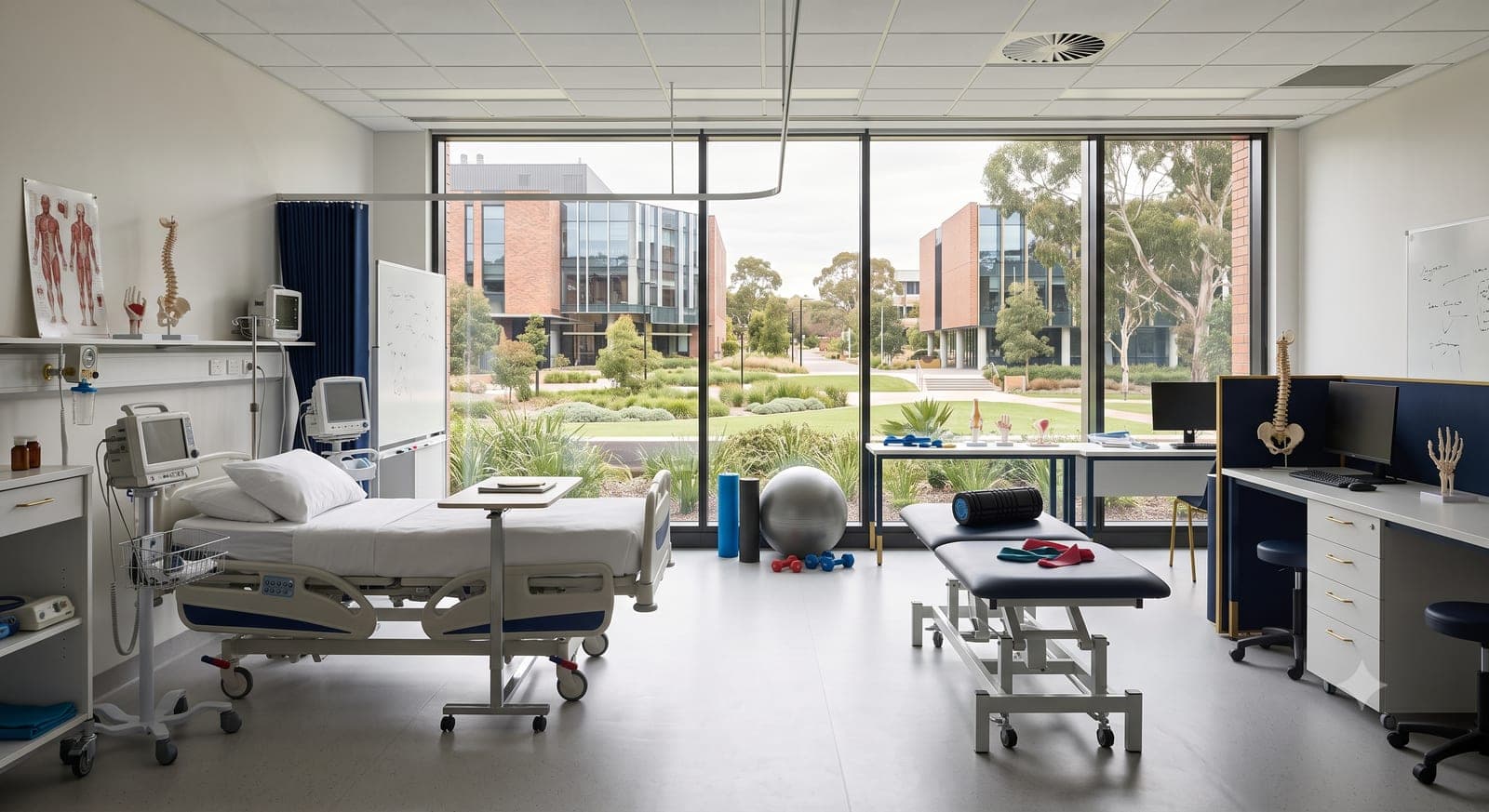
Nursing and physiotherapy are among the most popular healthcare study options for international students considering Australia.
Both offer professionally focused education, extensive practical training and opportunities to work across hospitals, clinics, aged care, rehabilitation, community health and other healthcare settings.
But there is an important difference between studying these subjects and studying a typical business or technology degree.
Nursing and physiotherapy are regulated professions in Australia.
That means the course you choose matters beyond the university name. The programme needs to meet the requirements of the relevant professional regulator, and graduating from an approved course does not by itself mean you are automatically registered to practise.
For nursing, the profession is regulated by the Nursing and Midwifery Board of Australia (NMBA) through the Australian Health Practitioner Regulation Agency, or Ahpra.
For physiotherapy, registration is overseen by the Physiotherapy Board of Australia, with the Australian Physiotherapy Council playing the accreditation role for Australian physiotherapy education programmes. (Ahpra, Australian Physiotherapy Council)
That makes course selection especially important for international students.
This guide explains the main nursing and physiotherapy courses in Australia, admission requirements, English requirements, clinical placements, tuition fees, professional registration, career prospects, student visa rules and post-study work options.
Why study Nursing or Physiotherapy in Australia?
Australia has a large healthcare system and an established higher education sector for health professions.
The latest Jobs and Skills Australia data currently available puts the number of Registered Nurses at around 366,200, with annual employment growth of approximately 12,600. The median full-time weekly earnings reported for registered nurses are $2,192, equivalent to a median hourly figure of $57. Registration with the Nursing and Midwifery Board of Australia is required to work in the profession. (Jobs and Skills Australia)
Physiotherapy is smaller as an occupation, but it is an established professional field. Jobs and Skills Australia currently reports approximately 29,000 physiotherapists in Australia, with median full-time weekly earnings of $1,888 and median hourly earnings of $50. Physiotherapists are primarily employed within Health Care and Social Assistance. (Jobs and Skills Australia)
These figures describe the Australian occupation as a whole.
They are not graduate starting salaries, and they should not be interpreted as a guarantee that an international student will find a job after graduation.
What makes these professions particularly interesting for students is the combination of academic study and practical clinical education.
Nursing vs Physiotherapy: what is the difference?
The two professions overlap in healthcare but have very different day-to-day roles.
Nursing
Nurses provide direct patient care, monitor patient conditions, administer treatments and medicines within their scope of practice, educate patients and work with other health professionals.
Nursing careers can lead into areas such as:
- Medical and surgical nursing
- Emergency nursing
- Intensive care
- Mental health
- Paediatrics
- Aged care
- Community health
- Perioperative nursing
- Critical care
- Public health
- Nurse education
- Advanced practice
- Nursing management
Jobs and Skills Australia describes registered nurses as working in hospitals, aged care, other healthcare facilities and community settings. (Jobs and Skills Australia)
Physiotherapy
Physiotherapists focus on movement, physical function, rehabilitation and the management and prevention of movement-related conditions.
This can involve:
- Musculoskeletal rehabilitation
- Sports injuries
- Neurological rehabilitation
- Cardiorespiratory care
- Paediatrics
- Aged care
- Chronic conditions
- Pain management
- Exercise prescription
- Movement retraining
- Private practice
Physiotherapy is therefore generally more focused on physical function and rehabilitation, whereas nursing covers a much broader range of patient care.
Neither profession is simply a classroom based career.
You need to be comfortable working directly with patients.
Nursing courses in Australia
For students who want to become registered nurses, the two most common study routes are:
- Bachelor of Nursing
- Graduate-entry Master of Nursing
There are also nursing qualifications for students who want to become enrolled nurses rather than registered nurses, but these follow a different professional pathway.
For an international student choosing a university course, the most important thing is to confirm that the programme is an approved programme of study.
Ahpra states that graduates of approved programmes are qualified to apply for registration, although graduates must still meet the other registration requirements and submit an application. (Ahpra)
Bachelor of Nursing in Australia
A Bachelor of Nursing is the standard undergraduate route for students who want to enter the registered nursing profession after school.
Most Australian Bachelor of Nursing degrees take around three years full time.
The curriculum typically combines:
- Nursing theory
- Anatomy and physiology
- Health assessment
- Clinical nursing
- Pharmacology
- Pathophysiology
- Communication
- Mental health
- Community nursing
- Aged care
- Medical and surgical nursing
- Professional practice
- Clinical placements
The practical component is particularly important.
For example, the University of Queensland's Bachelor of Nursing is a three-year full-time programme and includes up to 880 hours of supervised clinical placements across hospitals, critical care, emergency medicine, paediatrics, aged care, rural and mental health settings. (Study Australia)
This is what separates nursing education from many other undergraduate degrees.
You are not simply learning from textbooks.
You are expected to develop clinical skills in real healthcare environments.
Examples of Bachelor of Nursing courses
There are many Australian universities offering approved nursing programmes.
Here are some current examples.
University of Queensland
The Bachelor of Nursing is a three-year full-time programme.
The 2026 international estimated total course cost listed on Study Australia is approximately AUD $137,376.
The programme has a published IELTS overall requirement of 7 for the international course listing and includes substantial supervised clinical placement experience. (Study Australia)
Deakin University
Deakin's Bachelor of Nursing is a three-year full-time degree offered at Burwood, Geelong and Warrnambool.
The 2026 published annual international fee is approximately AUD $44,600.
The course is accredited through the Australian Nursing and Midwifery Accreditation Council and approved by the NMBA, making graduates eligible to apply for registered nurse registration after meeting the applicable requirements. (Deakin University, Deakin University)
Monash University
Monash's Bachelor of Nursing is also a three-year undergraduate option.
For students commencing in 2027, Monash lists an international tuition fee of approximately AUD $47,340 per standard full-time year, with fees subject to annual change. (Monash University)
These are examples rather than a ranking.
The right course depends on your entry profile, location, clinical training, tuition budget and career plans.
Can graduates from another degree study Nursing?
Yes, and this is one of the more useful pathways for students who have already completed university.
Several Australian universities offer graduate-entry Master of Nursing programmes that can lead towards registration as a registered nurse.
The University of Queensland, for example, offers a two-year Master of Nursing (Graduate Entry) for applicants who have completed a previous undergraduate or postgraduate degree in any discipline within the preceding ten years and who satisfy its academic requirements. The programme is designed around the Registered Nurse Standards for Practice developed by the NMBA. (UQ)
The 2026 international estimated total course cost for UQ's programme is listed by Study Australia at approximately AUD $100,064. (Study Australia)
This route can be attractive for someone who already has a bachelor's degree in areas such as:
- Biology
- Psychology
- Health Science
- Biomedical Science
- Exercise Science
or, depending on the institution, another discipline.
However, graduate-entry nursing is not the same as a generic Master's in nursing theory.
The programme must be an approved entry-to-practice course if your goal is registration as a registered nurse.
What is an approved nursing course?
This is one of the first things you should check.
Ahpra maintains a national list of Approved Programs of Study.
Ahpra states that an approved programme is a course that qualifies graduates for registration in the relevant health profession. Graduates still need to apply for registration and meet all applicable requirements. (Ahpra)
For nursing, the relevant professional body is the Nursing and Midwifery Board of Australia.
For students, the practical rule is simple:
Do not choose a nursing course based only on the course title.
Check that the exact programme is approved.
The same principle applies to physiotherapy.
Physiotherapy courses in Australia
Students normally enter physiotherapy through one of two routes:
- Bachelor of Physiotherapy
- or
- Graduate-entry Master or Doctor of Physiotherapy
The undergraduate route usually takes around four years.
Graduate-entry programmes commonly take around two years, although the exact structure varies between universities.
Physiotherapy programmes combine:
- Anatomy
- Physiology
- Biomechanics
- Exercise therapy
- Clinical reasoning
- Musculoskeletal physiotherapy
- Neurological physiotherapy
- Cardiorespiratory physiotherapy
- Rehabilitation
- Pain management
- Professional practice
- Clinical education
The goal is not simply to understand human movement.
You need to develop the clinical reasoning and practical skills needed to assess and treat patients.
Bachelor of Physiotherapy in Australia
A Bachelor of Physiotherapy is generally the direct route for students coming from secondary school.
The University of Queensland's Bachelor of Physiotherapy (Honours) is a current example.
It is a four-year full-time degree, with supervised clinical practice across hospitals, healthcare organisations, aged and community care, private practice and UQ's physiotherapy clinics.
The programme is accredited by the Australian Physiotherapy Council. (UQ)
The 2026 international tuition fee listed by UQ is approximately AUD $58,056 per year, while the total estimated course cost listed on Study Australia is approximately AUD $232,224 for the four-year degree. (UQ, Study Australia)
UQ's 2026 published admission information also lists an overall IELTS requirement of 7 for the international course listing.
The programme illustrates a broader point:
Physiotherapy is a highly practical degree.
Students should expect clinical teaching and placement requirements rather than treating it like a conventional classroom based science course.
Graduate-entry physiotherapy in Australia
Students who already have a bachelor's degree can consider a graduate-entry physiotherapy qualification.
The University of Queensland offers a two-year Master of Physiotherapy Studies.
It is designed for students who have completed an approved bachelor's degree and the required prerequisite study, including areas such as human anatomy and physiology.
The programme includes supervised clinical placements across UQ clinics, hospitals, schools, community services, aged care and private practices. (UQ)
The 2026 international course cost is listed at approximately AUD $75,590 per year, with the Study Australia database listing an estimated total cost of around AUD $158,740 for the two-year programme. (UQ, Study Australia)
This can be an attractive route for graduates because it allows them to move into the profession without beginning another four-year undergraduate degree.
But the prerequisite subjects are important.
A bachelor's degree alone does not necessarily make you eligible.
Other physiotherapy programmes worth researching
Monash University
Monash offers a Doctor of Physiotherapy, with professional recognition through accreditation endorsed by the Australian Physiotherapy Council on behalf of the Physiotherapy Board of Australia.
The programme provides training environments through partnerships with healthcare providers including The Alfred and Peninsula Health. (Monash University)
For 2027, Monash lists an international fee of approximately AUD $65,540 per 48 credit points.
La Trobe University
La Trobe's Master of Physiotherapy Practice is a two-year full-time graduate-entry programme.
The course combines simulated clinical education with placements in healthcare environments.
La Trobe states that the programme is accredited by the Australian Physiotherapy Council and that graduates may be eligible to apply for registration with the Physiotherapy Board of Australia. (La Trobe University)
For the 2026 course information, La Trobe lists a standard annual fee of AUD $52,000 per 120 credit points, subject to the student's circumstances and annual changes.
Nursing and Physiotherapy are not the same as other health degrees
This is worth emphasising because international applicants sometimes compare these courses with public health, health administration or health science.
A degree in:
- Public Health
- Health Management
- Health Science
- Biomedical Science
- Exercise Science
is not automatically a professional nursing or physiotherapy qualification.
For example, completing a general health science degree does not make you a registered nurse.
Likewise, an exercise science degree does not automatically make you a registered physiotherapist.
If your career goal is to become a registered nurse or physiotherapist, the education pathway needs to lead into the relevant professional registration process.
Ahpra's graduate registration guidance explicitly distinguishes approved programmes from other courses and notes that graduates of approved programmes can use the graduate application pathway. (Ahpra)
Clinical placements: one of the most important parts of the course
For health students, clinical placement is not an optional extra.
It is part of the education.
Nursing and physiotherapy programmes can require students to complete placements in hospitals, clinics, community services, aged care facilities and other healthcare environments.
The exact hours and placement arrangements vary.
UQ's Bachelor of Nursing, for example, includes up to 880 supervised clinical placement hours.
Deakin's combined Nursing and Midwifery degree includes 800 hours of nursing placement, with placements beginning in the first trimester.
UQ's Master of Physiotherapy Studies includes extensive supervised placements across a range of clinical environments.
This also creates additional practical requirements.
Depending on the university and placement provider, students may need:
- Immunisation records
- Vaccination evidence
- First Aid or CPR certification
- Police checks
- Working with Children checks
- Health screening
- Clinical uniforms
- Placement travel
- Other compliance documentation
UQ, for example, requires students on relevant health programmes to meet immunisation and placement preparation requirements, while physiotherapy students can have additional costs associated with CPR, first aid, uniforms and vaccinations. (UQ, UQ)
So when budgeting, don't look only at tuition.
English language requirements for Nursing and Physiotherapy
This area requires particular attention.
There are two separate questions:
What English score does the university require for admission?
and
What English standard must you meet for professional registration?
They are not always identical.
For professional registration, Ahpra's current English language framework was updated in 2026.
For National Board professions covered by the common standard, including physiotherapy, the current requirements for tests taken on or after 23 April 2026 include:
| Test | Overall | Listening | Reading | Writing | Speaking |
|---|---|---|---|---|---|
| IELTS Academic | 7.0 | 7.0 | 7.0 | 6.5 | 7.0 |
| PTE Academic | 63 | 58 | 59 | 60 | 76 |
| TOEFL iBT | 91 | 22 | 22 | 23 | 24 |
The English language standard allows specified results from one sitting or, subject to detailed conditions, a maximum of two sittings within 12 months. (Ahpra)
Nursing has a separate NMBA English language standard.
The current nursing requirements retain IELTS Academic at 7.0 overall, with 7.0 in Listening, Reading and Speaking and 6.5 in Writing. The revised standard also uses PTE Academic at 63 overall, with 58 Listening, 59 Reading, 60 Writing and 76 Speaking for tests taken from 23 April 2026. (NMBA, Ahpra)
This is a significant 2026 update for applicants who are still using older PTE preparation material.
The important point is that the registration standard should not be confused with the university's admission requirement.
A university can set its own English requirement.
For example, UQ's Bachelor of Nursing and Bachelor of Physiotherapy course listings currently publish an overall IELTS requirement of 7.
Always check the actual programme you are applying to.
Can I use PTE for Nursing or Physiotherapy?
PTE Academic is an accepted English test under the current Australian health practitioner registration framework.
The NMBA specifically lists PTE Academic among its accepted tests for nursing registration, while Ahpra's common framework lists it for physiotherapy and other regulated professions. (NMBA, Ahpra)
But students should still check the university's admission policy.
The university's accepted test list can be different from the regulator's list.
Also check whether the result must come from a particular test centre format and whether the institution accepts a two-sitting combination.
How professional registration works after graduation
Finishing the course is not the final step.
For a graduate of an approved Australian programme, the next stage is registration.
Ahpra's graduate registration system is available to students completing approved programmes in regulated health professions, including nursing and physiotherapy. Students can begin the application process before completing the course. (Ahpra)
The process includes satisfying the relevant registration standards.
These can include:
- English language skills
- Criminal history requirements
- Recency of practice where relevant
- Professional indemnity requirements
- Other profession specific requirements
The exact requirements depend on the profession and applicant.
That is why the phrase “course completion leads to registration” should be used carefully.
The accurate statement is:
Completing an approved programme makes you eligible to apply for registration, subject to meeting the regulator's requirements.
What if I am already a nurse in India or another country?
This is a different pathway.
You do not necessarily need to study a full Australian Bachelor of Nursing again.
Internationally qualified nurses who want Australian registration may need to go through the NMBA's internationally qualified nurse pathways.
The NMBA currently has a specific registration standard for internationally qualified registered nurses, alongside the existing assessment process for applicants who do not meet the criteria of the streamlined standard. (NMBA)
The broader internationally qualified nurse process can involve self-checks, orientation and outcomes-based assessment for eligible candidates. (NMBA)
So an experienced nurse should not automatically assume that studying another Australian nursing degree is the correct solution.
Your existing qualification may need to be assessed first.
What if I am already a physiotherapist?
The situation is similar, but the regulator and assessment pathway are different.
The Australian Physiotherapy Council is the assessment authority for overseas-qualified physiotherapists who want to practise in Australia.
The Council currently operates several pathways, including:
- Australian Physiotherapy Entry Pathway (APEP)
- FLYR
- Express FLYR
The appropriate pathway depends on the applicant's qualification, country of training and eligibility. Successful candidates then proceed towards general registration with Ahpra. (Australian Physiotherapy Council)
The APEP pathway currently involves eligibility assessment, cultural safety training, written assessment, capability assessment and a clinical workshop. (Australian Physiotherapy Council)
So, once again:
Studying a new physiotherapy degree and having an existing physiotherapy qualification assessed are two different routes.
Career options after Nursing
Nursing is a broad profession.
Graduates can work across:
- Hospitals
- Aged care
- Community health
- Mental health
- Emergency care
- Paediatrics
- Medical and surgical units
- Operating theatres
- Rehabilitation
- Primary care
- Public health
After gaining experience, nurses can progress into clinical leadership, education, management and advanced practice.
The Australian nursing workforce is large, with Jobs and Skills Australia currently reporting 366,200 registered nurses and annual employment growth of 12,600 based on the latest published profile.
That provides useful context, but individual employment outcomes still depend on registration, location, employer demand, experience and the graduate's circumstances.
Career options after Physiotherapy
Physiotherapists can work in:
- Hospitals
- Private clinics
- Sports rehabilitation
- Community health
- Rehabilitation centres
- Aged care
- Industrial health
- Paediatrics
- Neurological rehabilitation
- Cardiorespiratory care
- Research
- Education
- Management
- Private practice
Jobs and Skills Australia currently records around 29,000 physiotherapists in Australia, with the main employing industry being Health Care and Social Assistance. (Jobs and Skills Australia)
La Trobe's current physiotherapy programme information also lists private practice, general hospitals, rehabilitation centres, community health centres, industrial clinics and specialist centres among employment settings. (La Trobe University)
How much does Nursing cost in Australia?
Tuition varies significantly by university.
Current examples include:
| Nursing programme | Duration | International fee reference |
|---|---|---|
| UQ Bachelor of Nursing | 3 years | Approx. AUD $137,376 total for 2026 |
| Deakin Bachelor of Nursing | 3 years | Approx. AUD $44,600 per year for 2026 |
| Monash Bachelor of Nursing | 3 years | Approx. AUD $47,340 per year for 2027 |
| UQ Master of Nursing (Graduate Entry) | 2 years | Approx. AUD $100,064 total |
(Study Australia, Deakin, Monash, Study Australia)
These figures are examples rather than a national average.
They also use different fee structures, so students should not compare one university's annual fee directly with another university's total programme cost.
How much does Physiotherapy cost in Australia?
Current examples show a similarly wide range.
| Physiotherapy programme | Duration | International fee reference |
|---|---|---|
| UQ Bachelor of Physiotherapy (Honours) | 4 years | Approx. AUD $232,224 total for 2026 |
| UQ Master of Physiotherapy Studies | 2 years | Approx. AUD $158,740 total |
| Monash Doctor of Physiotherapy | Graduate-entry | Approx. AUD $65,540 per year for 2027 |
| La Trobe Master of Physiotherapy Practice | 2 years | Approx. AUD $52,000 per year for 2026 |
(UQ, Study Australia, Monash, La Trobe)
Again, these are published examples for particular intakes.
Fees can increase from year to year.
What does the Australian Student visa allow?
International students studying eligible courses on a Student visa can generally work up to 48 hours per fortnight while their course is in session.
When the course is not in session, students can generally work unlimited hours.
There are different rules for some research Master's and doctoral students. (Australian Department of Home Affairs)
For nursing and physiotherapy students, work can be useful for additional income and Australian workplace experience.
But your financial plan should not depend on finding a part-time job immediately after arrival.
Health degrees are demanding, and clinical placement schedules can also make employment harder to manage at certain points in the course.
A major Student visa change from October 2026
Students planning to apply now should also be aware that Australia's Student visa rules changed on 2 October 2026.
The new rules affect who can lodge certain Student visa applications from inside Australia and change the circumstances in which family members can be included in a Student visa application.
Most Student visa applicants must now lodge from outside Australia unless an exemption applies, and most applicants can no longer include partners or dependent children unless they fall within an applicable exemption. (Department of Home Affairs)
That is a very recent rule change.
Students planning to study in Australia should therefore be particularly careful with advice written before October 2026.
What are the current Student visa costs?
Australia increased the Student visa application charge from AUD $2,000 to AUD $2,500 from 1 July 2026. (Study Australia)
Students must also maintain Overseas Student Health Cover and meet the applicable financial capacity and other visa requirements.
The current published living-cost figure used for financial capacity for a single student is AUD $29,710 for 12 months. (Department of Home Affairs)
This is a visa financial requirement.
It should not automatically be treated as the amount every student will actually spend.
Accommodation, city, transport and lifestyle can make real expenditure higher.
What happens after graduation?
Australia's Temporary Graduate visa, subclass 485, can allow eligible graduates to remain temporarily after completing an eligible Australian degree.
Under the current Post-Higher Education Work stream, the standard stay period is:
- Bachelor's degree: 2 years
- Master's by coursework or extended study: 2 years
- Master's by research: 3 years
Doctoral degree: 3 years.
There is a specific arrangement for eligible Indian nationals under the Australia India Economic Cooperation and Trade Agreement.
For eligible Indian graduates:
- Bachelor's degree: 2 years
- Master's degree: 3 years
- Doctoral degree: 4 years. (Department of Home Affairs)
This is particularly relevant to Indian students considering graduate-entry Master's programmes in nursing or physiotherapy.
There are, however, other eligibility requirements, including age, recent study, English, health and character requirements.
The current general age requirement is 35 or under when applying, with exceptions including certain Master's by research and doctoral applicants. (Department of Home Affairs)
Does a nursing or physiotherapy degree guarantee permanent residency?
No.
This is an important distinction.
Studying a healthcare course can create a pathway into a regulated Australian profession and may provide access to graduate work rights where the visa requirements are met.
It does not automatically result in permanent residency.
Your future immigration options depend on the visa and migration rules in force at that time, your occupation, registration, work experience, location, eligibility and other requirements.
The same applies to claims that a particular university or state will “guarantee PR”.
No university course can guarantee that outcome.
What are the entry requirements for Nursing?
Entry requirements vary by university.
For undergraduate nursing, students usually need:
- Secondary school qualification equivalent to Australian Year 12
- Required academic subjects where specified
- English proficiency
- Any university specific prerequisites
- Health and placement requirements
For postgraduate graduate-entry nursing, universities may require:
- A bachelor's degree
- Minimum academic performance
- Prerequisite subjects
- English language proficiency
- Additional health or placement requirements
For example, UQ's Master of Nursing (Graduate Entry) is designed for applicants who have completed a previous degree and meet the programme's requirements. (UQ)
The important point is that admission requirements are programme specific.
What are the entry requirements for Physiotherapy?
For undergraduate physiotherapy, universities can require:
- Year 12 equivalent qualification
- English
- Biology, chemistry or physics depending on the programme
- Competitive academic results
- Health and placement requirements
UQ's Bachelor of Physiotherapy (Honours), for example, requires General English plus one of Biology, Chemistry or Physics at the relevant senior secondary level. (UQ)
For graduate-entry physiotherapy, the requirements are usually more specialised.
Students may need previous study in:
- Anatomy
- Physiology
- Psychology
- Statistics
- Exercise science
- Other health or science subjects
UQ's Master of Physiotherapy Studies, for example, requires an approved bachelor's degree and prerequisite study in relevant areas including human anatomy and physiology. (UQ)
Nursing vs Physiotherapy: which course suits you?
The decision should be based on the kind of healthcare work you want to do.
Nursing may suit you when you enjoy:
- Patient care
- Hospital environments
- Clinical decision making
- Working as part of multidisciplinary teams
- Medication and treatment support
- Longitudinal patient care
- Emergency and acute care
- Community and aged care
Physiotherapy may suit you when you enjoy:
- Human movement
- Exercise
- Rehabilitation
- Musculoskeletal conditions
- Sports injuries
- Neurological rehabilitation
- Physical recovery
- One-to-one clinical interaction
- Patient education
There is no universally better course.
They lead into different professions.
Common mistakes international students make
Choosing a course only because healthcare jobs are in demand
Demand matters.
But you also need to enjoy the work.
Both nursing and physiotherapy involve direct patient contact, clinical responsibility and professional standards.
Choosing a non-approved course
Always check the relevant regulator.
For nursing, verify NMBA approval.
For physiotherapy, verify accreditation and the relevant approved programme status. (Ahpra, Australian Physiotherapy Council)
Assuming your university English score is the only English requirement
The university and professional regulator can have separate requirements.
This is particularly important in regulated health professions.
Ignoring clinical placement requirements
Placements can involve vaccinations, checks, uniforms, travel and other costs.
Choosing a Master's without checking whether it is entry-to-practice
Not every Master of Nursing or health-related Master's leads to initial professional registration.
Assuming a short course makes you a registered professional
A certificate, graduate diploma or general health degree is not automatically equivalent to an approved entry-to-practice professional qualification.
Treating post-study work rights as guaranteed employment
The Temporary Graduate visa provides temporary work rights for eligible graduates.
It does not provide a job.
Assuming a healthcare degree guarantees PR
Migration rules are separate from education.
A practical checklist before applying
Before paying an application fee or tuition deposit, check these details.
For Nursing
Is the exact course NMBA approved?
Does the programme lead towards registered nurse registration?
How many clinical placement hours are included?
What is the university's English requirement?
What English standard will I need for registration?
What are the immunisation and police check requirements?
What is the total tuition cost?
What is the realistic cost of living in that city?
For Physiotherapy
Is the programme accredited by the Australian Physiotherapy Council?
Is it approved for the professional registration pathway?
Does it qualify as an entry-to-practice course?
What anatomy and physiology prerequisites are required?
How much clinical placement is included?
What English score does the university require?
What will I need for Physiotherapy Board registration?
What additional placement costs should I budget for?
These questions are more useful than simply asking which university has the highest ranking.
Nursing vs Physiotherapy in Australia
| Factor | Nursing | Physiotherapy |
|---|---|---|
| Main professional regulator | Nursing and Midwifery Board of Australia | Physiotherapy Board of Australia |
| Accreditation / approval | NMBA approved programme, with Ahpra registration process | Australian Physiotherapy Council accreditation and Board registration |
| Undergraduate route | Usually 3 years | Usually 4 years |
| Graduate-entry route | 2 year Master available at some universities | 2 year graduate-entry programmes available at some universities |
| Main focus | Patient care and clinical nursing | Movement, rehabilitation and physical function |
| Major workplaces | Hospitals, aged care, community care, mental health and other health settings | Hospitals, private practice, rehabilitation, community care, aged care and specialist clinics |
| Clinical placement | Major part of the degree | Major part of the degree |
| Registration after graduation | Must apply to NMBA through Ahpra and meet standards | Must apply to Physiotherapy Board through Ahpra and meet standards |
| English | University requirements plus NMBA registration standard | University requirements plus applicable Ahpra/Board standard |
| Current workforce reference | 366,200 registered nurses | 29,000 physiotherapists |
Workforce figures are from the latest Jobs and Skills Australia profiles currently available and should not be interpreted as graduate job guarantees.
Final thoughts
Nursing and physiotherapy can both provide highly practical healthcare education in Australia.
But neither should be approached as simply another international degree.
You are entering a regulated profession.
That means the university matters.
The exact programme matters.
The accreditation matters.
Clinical placement matters.
English proficiency matters.
Professional registration matters.
And for international students, the visa rules matter as well.
For nursing, the Australian system currently recognises approved programmes through the NMBA and Ahpra, while physiotherapy programmes are accredited through the Australian Physiotherapy Council and approved through the relevant regulatory framework. (Ahpra, Australian Physiotherapy Council)
The latest workforce information also shows that both professions have established roles within Australia's healthcare system, with around 366,200 registered nurses and 29,000 physiotherapists represented in current Jobs and Skills Australia data.
But the most important question is not:
“Which healthcare course is easiest to get into?”
It is:
“Which profession actually suits the kind of healthcare work I want to do?”
Choose nursing if you see yourself providing broad patient care across hospitals, community services or other clinical settings.
Choose physiotherapy if you are more interested in movement, rehabilitation, exercise and helping patients recover physical function.
Then work backwards from the profession.
Check the regulator.
Check the approved programme.
Check the entry requirements.
Check the clinical placements.
Calculate the full cost.
Understand the registration process.
And only then choose the university.
That approach may take a little more research at the beginning.
For a regulated healthcare profession, it can save you from making a very expensive mistake later.
Frequently Asked Questions
Which is better, Nursing or Physiotherapy in Australia?
They lead to different professional careers. Nursing focuses on patient care across a broad range of healthcare settings, while physiotherapy focuses primarily on movement, rehabilitation and physical function.
Can I study Nursing in Australia after 12th?
Yes. A Bachelor of Nursing is the common undergraduate route and typically takes about three years full time. Programmes must meet the applicable professional approval requirements if your goal is registration as a registered nurse.
Can I study Physiotherapy in Australia after 12th?
Yes. Bachelor of Physiotherapy programmes commonly take around four years. Specific prerequisites can include English and one or more science subjects such as Biology, Chemistry or Physics. (UQ)
Can graduates from another field study Nursing in Australia?
Some universities offer two-year graduate-entry nursing Master's programmes. UQ's Master of Nursing (Graduate Entry), for example, accepts applicants with a previous undergraduate or postgraduate degree in any discipline, subject to the programme's requirements. (UQ)
Can I study Physiotherapy after another bachelor's degree?
Yes, at universities offering graduate-entry programmes. You will usually need specific prerequisite subjects. UQ's Master of Physiotherapy Studies, for example, requires relevant prior study including anatomy and physiology. (UQ)
Do I need IELTS 7 for Nursing in Australia?
The university admission requirement depends on the course. For professional registration, the current NMBA English standard retains IELTS Academic at overall 7.0, with 7.0 in Listening, Reading and Speaking and 6.5 in Writing. (NMBA, Ahpra)
Can I use PTE for Nursing registration?
Yes. For tests taken from 23 April 2026, the current NMBA PTE Academic requirement is overall 63, with 58 Listening, 59 Reading, 60 Writing and 76 Speaking, subject to the detailed registration rules. (NMBA, Ahpra)
How much does Nursing cost in Australia?
It depends on the university and programme. Current examples include approximately AUD $44,600 per year at Deakin for 2026 and approximately AUD $47,340 per year at Monash for 2027, while UQ's published 2026 estimated total for its Bachelor of Nursing is approximately AUD $137,376.
How much does Physiotherapy cost in Australia?
Current examples include approximately AUD $58,056 per year for UQ's Bachelor of Physiotherapy (Honours), approximately AUD $75,590 per year for UQ's Master of Physiotherapy Studies, AUD $65,540 per year for Monash's Doctor of Physiotherapy for 2027, and AUD $52,000 per year for La Trobe's 2026 Master of Physiotherapy Practice.
Can I work while studying Nursing or Physiotherapy in Australia?
Eligible Student visa holders can generally work up to 48 hours per fortnight while their course is in session and unlimited hours during scheduled breaks. Placement schedules can affect how much additional work a student can realistically take on. (Department of Home Affairs)
Can I stay in Australia after completing Nursing or Physiotherapy?
Eligible graduates may be able to apply for the Temporary Graduate visa. Under the current rules, eligible Indian Master's graduates can receive up to three years in the Post-Higher Education Work stream. Other graduates receive periods based on the qualification and applicable nationality arrangements. (Department of Home Affairs)
Does a Nursing or Physiotherapy degree guarantee PR in Australia?
No. Professional registration, post-study work rights and permanent migration are separate matters. A healthcare qualification can be part of an individual's longer term plans, but it does not guarantee permanent residency.
Is Nursing in demand in Australia?
Registered Nursing is a large Australian occupation. Jobs and Skills Australia currently reports approximately 366,200 registered nurses and annual employment growth of around 12,600 in its latest published profile.
Is Physiotherapy in demand in Australia?
Physiotherapy is an established healthcare profession with approximately 29,000 physiotherapists recorded in the latest Jobs and Skills Australia profile. Employment is concentrated mainly in Health Care and Social Assistance.
What if I am already a qualified nurse or physiotherapist in India?
Do not automatically enrol in another full degree. Internationally qualified nurses and physiotherapists can have separate assessment and registration pathways. Nurses may fall under the NMBA's internationally qualified nurse framework, while overseas-qualified physiotherapists are assessed through the Australian Physiotherapy Council.
Thinking about studying Nursing or Physiotherapy in Australia? TIRO Education can help you compare approved programmes, assess your academic eligibility, understand English and clinical requirements, and build a study plan around your career goals and budget.
Information in this article reflects Australian university, Ahpra, NMBA, Australian Physiotherapy Council, Jobs and Skills Australia and Department of Home Affairs information available in October 2026. Course fees, accreditation, admission requirements, registration standards and visa rules can change. Students should verify the exact programme and current requirements directly with the university and relevant Australian regulator before applying or making a financial commitment.